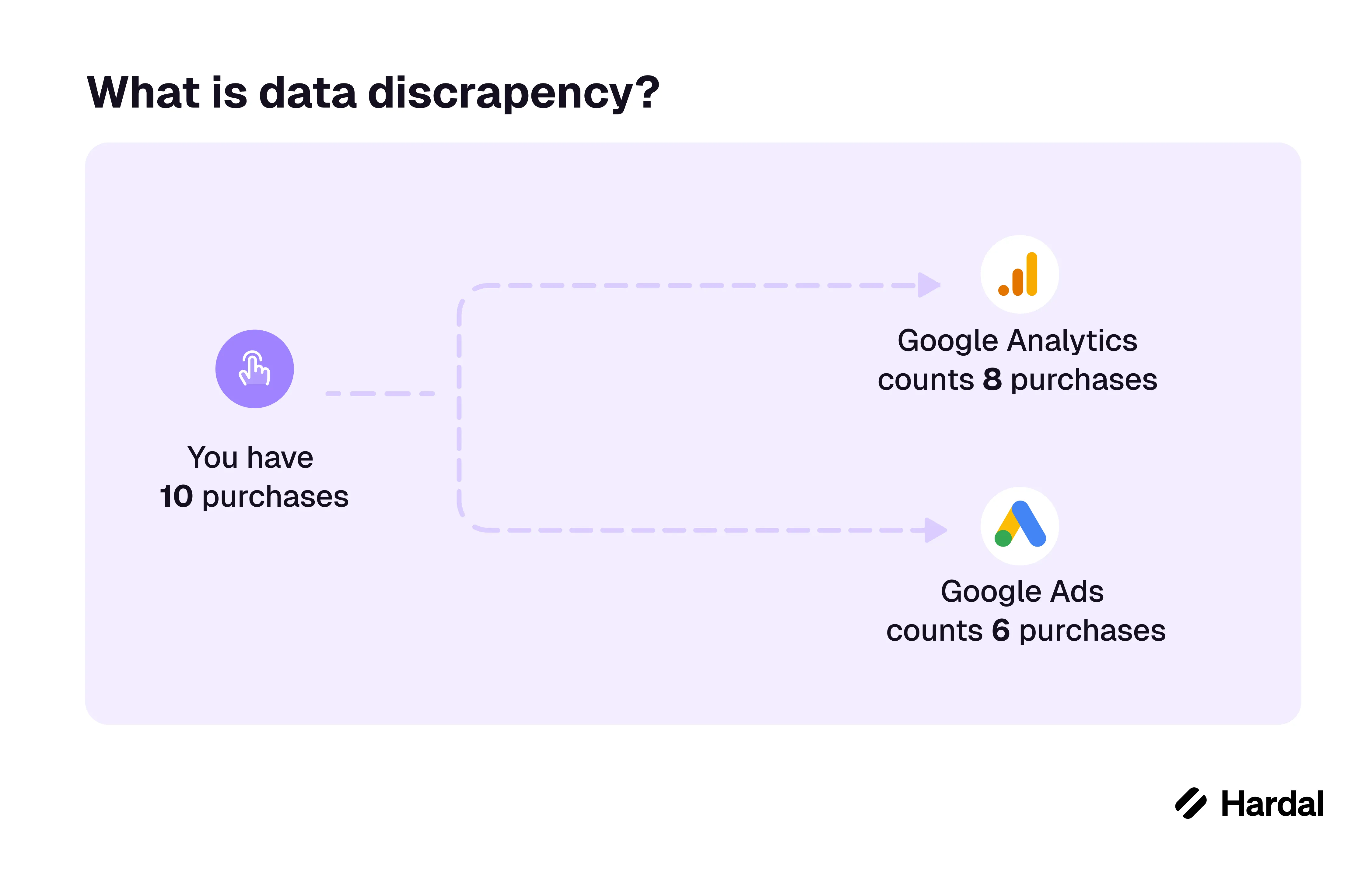
What is Data Discrepancy?

Data discrepancy occurs when different analytics platforms report conflicting numbers for the same metrics, events, or time periods.

What is Data Discrepancy?

Data discrepancy occurs when different analytics platforms report conflicting numbers for the same metrics, events, or time periods.

This is common in digital marketing and analytics, arising from differences in tracking methodologies, attribution models, data processing timing, and measurement definitions across platforms.

Understanding why discrepancies happen helps teams set realistic expectations, establish acceptable variance thresholds, and focus on trends rather than absolute precision when comparing cross-platform data.

Hardal Data Discrepancy

In the Marketing Engineering world, everyone measures data with different tools and has, at some point, noticed that the numbers don't align.
The inconsistency between two data sources is called a data discrepancy.

For example, a channel-level conversion performance report from Google Analytics might not match the data you see in Adjust.
If you're dealing with large volumes of data and high-budget operations, this inconsistency can be stressful — but it doesn't always mean something's wrong.


Why Don't the Numbers Match?

Even when we look at the same metrics, the numbers may differ.
This is not due to system errors — it's due to differences in measurement philosophy.
Once we understand why the differences exist, they stop being scary.


1. Measurement Models

Each platform measures events and sessions differently:

  • GA4: Measures client-side, using an event-based model.
  • Meta: Uses its own pixel, counting conversions only from its own signals or clicks.
  • Hardal: Uses a server-side and cookieless measurement approach.

2. Attribution Models

Every platform applies its own attribution rules and conversion logic:

  • GA4: Uses a data-driven model by default, but also includes Last Click and other models.
  • Hardal: Lets you choose the attribution model (Last Click, First Click, etc.).

Therefore, the answer to "Where did the conversion come from?"
can differ from one platform to another.

3. Time Zones and Processing Delays

When you create a channel breakdown report in GA4 early in the morning,
you might notice different results later in the day.
That's because full data processing may be delayed — and these delays can create data gaps or mismatches.

Privacy policies like Consent Mode and App Tracking Transparency (ATT) make some users invisible.
GA4 compensates for this by modeling missing users, while Hardal only reports observed data.

In short: GA4 models your data, Hardal shows your data and that's where discrepancies begin.

5. Technical Integration Differences

  • SDK version changes
  • Server vs client event sending
  • Missing parameters (session_id, user_id)
  • API delays or errors

Each of these factors may seem small but can accumulate over time, creating noticeable data gaps.

The Truth: 100% Match Is Unrealistic

With so many variables, expecting a 100% match between platforms is unrealistic.
The key is to pay attention to which metric, from which source, and under which parameters the data is collected.

Example recommendations:

  • When analyzing purchases, use transaction_id for matching — it will reduce discrepancies.
  • When counting users, use user_id to align data more accurately between platforms.

What Do These Differences Teach Us?

Discrepancies actually show us what kind of insights we can extract from each platform.
For instance, the fact that you can't see users without ATT consent in Adjust might tell you that you need a different data source to fill that gap.

What starts the day as a major problem often ends up being an opportunity once we understand the causes behind the differences.

FAQ: Data Discrepancy

What is data discrepancy?

Data discrepancy is the inconsistency between two data sources reporting on the same metric. It's common and usually stems from differences in measurement approaches rather than system errors.

Why do GA4 and Adjust (or other platforms) show different numbers?

Platforms measure events, sessions, and users differently, apply different attribution models, operate in different time zones, and may include modeled data (like GA4) versus observed data (like Hardal). These factors create natural differences.

Is a 100% match between platforms realistic?

No. Because of measurement models, attribution rules, processing delays, privacy constraints, and technical variations, a perfect match is unrealistic. Focus on clear metric definitions and consistent parameters instead.

How do attribution models cause discrepancies?

Different platforms use different models (e.g., data-driven, last click, first click). The same conversion can be credited to different sources, resulting in different channel breakdowns.

Do time zones and processing delays affect my reports?

Yes. Early reports can change as data finishes processing. Mismatched time zones across tools also shift when events are counted.

Consent frameworks like Consent Mode and ATT can hide some users. GA4 can model missing users, while Hardal reports only observed data, leading to differences.

How can I reduce discrepancies?

Align identifiers and parameters across tools. For purchases, use a stable transaction_id; for users, use user_id. Keep event names consistent and verify technical integrations (SDK versions, server vs client, required params).

Ready to switch to Hardal?

Cookieless analytics and first-party data platform for websites and mobile apps.